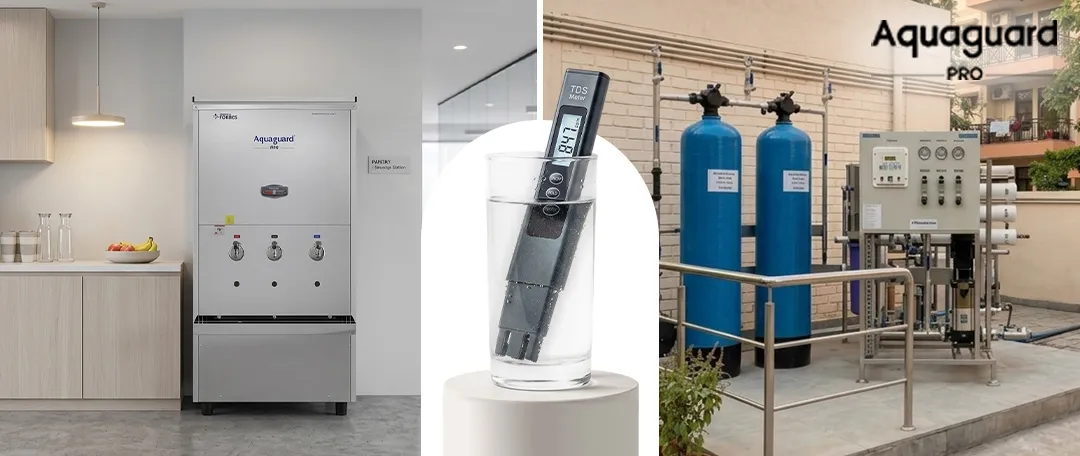
High TDS Water in Indian Cities: Which Commercial Water Purifier Technology is Right for You?
PUBLISHED ON: 19-Oct-2026
Key Takeaways
- TDS levels in Indian cities vary and largely depend on the source of water.
- High TDS water generally requires RO-based purification.
- If the main concern is microbial contamination and TDS is low, UV and UF systems can be practical options.
- The choice of a commercial water purifier depends on the water quality, daily consumption, and size of the facility.
Water quality differs across India. While some cities depend primarily on municipal supply, others rely on borewells or tanker water. Therefore, the level of dissolved salts and minerals can vary from city to city.
When it comes to commercial water purifiers for offices, schools, hospitals, restaurants, or industrial facilities, capacity is not the only factor. Water quality is also important. Understanding TDS levels and the existing technologies can help businesses choose a system that delivers safe, dependable drinking water.
What Is TDS and Why Does It Matter for Commercial Spaces?
TDS (total dissolved solids) refers to the overall concentration of minerals, salts, and other dissolved substances in water. While some minerals, like calcium and magnesium, are good, in excess, they can affect the taste and quality of the water.
High-TDS water in commercial settings can cause scale buildup in dispensers, pipelines, and other equipment, reducing drinking water quality and increasing maintenance costs.
As per BIS norms, drinking water with a TDS level of up to 500 mg/litre is considered acceptable¹.
TDS Levels In Major Indian Cities
TDS levels can vary from city to city and even within the same city, depending on the source of water. Usually, municipal water supplies have lower TDS levels, whereas borewell and tanker water often have higher levels of dissolved salts.
Given below are examples of average TDS levels in major Indian cities (actual values may vary):
- Kanpur: Average TDS level is approximately 433.6mg/L².
- Bengaluru: TDS level is generally in the range of 394-812 mg/L³.
- Gurugram: TDS level in some districts has increased to around 5140mg/L⁴.
- Delhi: TDS levels generally range from 170-7890 mg/L in the southwest Delhi region⁵. [KJ2.1]
Since water quality may differ considerably, testing the source water before investing in a commercial purification system is always advisable.
Understanding Commercial Water Purifier Technologies
No single purification technology works for every situation. The proper choice depends on the level of TDS and the type of contaminants in the water.
Reverse Osmosis (RO)
Reverse osmosis (RO) technology removes dissolved salts, fluoride, heavy metals, nitrates, and other impurities. It is generally recommended when the TDS level is above 500 ppm.
Big enterprises with 200+ employees working in areas with high TDS levels may consider installing an RO plant. However, the cost of an RO water plant depends on factors such as capacity, features, and purification technology used. Some have simpler designs, while others combine multiple technologies such as RO and UV for more comprehensive purification.
Ultraviolet (UV) Purification
Ultraviolet (UV) purification uses ultraviolet light to remove bacteria, viruses and other microbes. It does not reduce TDS, so it is most effective for municipal water supplies with low TDS that require protection against microbial contamination.
Multi-stage purification systems
Many of the modern commercial water purifiers are multi-stage purification systems using a combination of RO and UV purification technologies. Multi-stage systems are very useful for complete purification in areas where water contains both dissolved impurities and microbial contaminants.
What Should You Look for in a Commercial Water Purifier for High-TDS Areas?
There are certain factors you should pay attention to when selecting a commercial water purifier. These factors include:
Daily Water Requirement
The purifier should be able to meet the daily drinking water demand without interruptions. The capacity requirements depend on the number of employees or users.
Appropriate Purification Technology
RO systems are often selected in high TDS areas, UV is considered where microbial contamination is a risk. Combination technologies such as RO+UV provide protection from a wider range of contaminants.
Storage Capacity
Adequate storage helps ensure a continuous supply of drinking water during peak usage. If your business needs both purified and chilled water, then you should look for a drinking water cooler with sufficient storage capacity to meet the daily water needs of your employees. For example, a business with 100-115 employees can consider a water cooler with a 50 L storage capacity.
Water Recovery
Modern RO systems are designed to maximise water recovery and minimise wastage, making them more suitable for commercial applications.
Maintenance Ease
Spare parts, service support, and annual maintenance options can make long-term operations easier and more reliable.
Which Commercial Water Purifier To Choose?
Eureka Forbes provides a wide range of commercial water purifiers for you to choose from:
1. Aquaguard Prima 100-B Commercial Water Purifier:
BIS-approved commercial water purifier, suitable for all sources of water.
- 7 stages of advanced purification for clean & purified water for daily use.[KJ3.1]
- Saves up to 40% of water.[KJ4.1]
- Comes with a self-cleaning system that automatically flushes the RO membranes, reducing maintenance and increasing the lifespan of the system.
2. Aquaguard Purechill 80 SS UV+ CuZn Water Cooler with inbuilt Purifier and Storage:
A multi-stage UV purification system that ensures clean drinking water effortlessly.
- Consists of a 4-stage advanced purification providing pure and chilled drinking water.
- Comes with an active copper and zinc booster, which infuses the right amounts of copper and zinc into the water to promote overall health and well-being.
- Features an 80L storage capacity, suitable for high usage.
- Tough, durable and corrosion-resistant body, preventing contamination of drinking water.
While comparing the models available in the market, it is wise to look beyond the water cooler price and evaluate other aspects such as storage capacity, purification technology and maintenance requirements to ensure apt selection.
Regular Servicing Is as Important as the Technology
Technology is just one side of the equation. Regular servicing is equally important. A water cooler or RO plant needs regular servicing to perform efficiently, like any other appliance. This is because filters and membranes get clogged with impurities over time, impacting water quality and the system’s performance.
Conclusion
Water quality varies significantly across Indian cities, indicating that a one-size-fits-all commercial water purification approach is not feasible. The right technology choice depends on several factors, including the quality of source water, daily consumption, and the type of contaminants. Water testing before selecting a commercial purifier is always recommended.
References
- https://law.resource.org/pub/in/bis/S06/is.10500.2012.pdf
- https://www.researchgate.net/publication/379782866_QUALITATIVE_ANALYSIS_OF_UNDERGROUND_WATER_IN_INDUSTRIALURBAN_AREAS_OF_KANPUR
- http://www.sedindia.in/ewijst/issues/vol6/ewijst060313038.pdf
- https://www.internationaljournalssrg.org/IJAES/2024/Volume11-Issue5/IJAES-V11I5P104.pdf
- https://pmc.ncbi.nlm.nih.gov/articles/PMC5998705/
Frequently Asked Questions (FAQs)
What TDS level is considered high and requires a commercial RO water purifier?
Generally, TDS levels above 500 ppm are considered to be high, and it often requires RO purification to effectively remove dissolved salts and other contaminants.
Can a UV commercial water purifier handle high-TDS water in offices?
No, UV technology is designed for killing microorganisms. High TDS water generally requires RO-based purification.
What is the ideal commercial water purifier technology for a large office or commercial space with more than 50 employees?
It depends on the location of your office. If your office is situated in a high TDS region, then investing in an RO-based water cooler can be a practical choice. If it is located in a low TDS region and your concern is microbial contamination, then a UV-based system may be appropriate.
