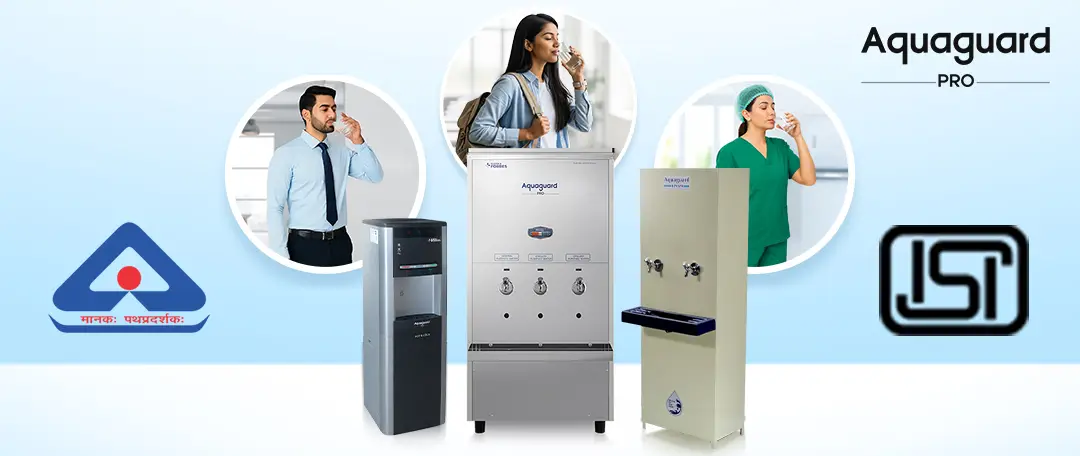
Water Purifier Compliance & BIS/IS Standards for Commercial Establishments in India
PUBLISHED ON: 05-May-2026
Key Takeaways
- A BIS-certified water purifier is essential for regulatory compliance and safe drinking water in commercial spaces
- Standards such as IS 16240 and IS 10500 define performance, safety, and water quality benchmarks
- Regular maintenance, testing, and documentation are as important as the equipment itself
- Food and beverage businesses must also align with FSSAI norms
- Non-compliance can lead to penalties, operational disruption, and reputational risk
Let’s begin with an interesting example to understand the concept better.
Rajiv has recently opened a fine- dining restaurant in Vasant Kunj. From vendor coordination to customer experience, he was managing everything on his own. He even installed a commercial water purifier for his customers and employees to ensure everyone drinks only safe and clean water. But one thing escaped from his attention: BIS compliance for his water purifier. It was only during the routine inspection that he found out that simply installing a water purifier is not enough. Certain quality standards should also be maintained to ensure a consistent supply of safe and clean drinking water.
For businesses, water quality directly correlates with health, regulations and reliability. They are expected to offer clean drinking water continuously to their employees or customers, regardless of size.
For this, they use equipment such as BIS-approved water purifiers with solutions such as water coolers, or RO plants.
Compliance with regulations does not only include the procurement of equipment but also maintaining the required standards and performing regular maintenance as well.
Why Commercial Establishments Face Stricter Scrutiny
Commercial establishments face stricter water quality standards and regulations because lapses of any kind can affect a large and varied group of people. The combination of high usage, public exposure, and regulatory oversight makes compliance critical for them.
High water usage at scale
Commercial spaces consume significantly larger volumes of water every day. This constant demand requires reliable and efficient purification systems, often supported by an RO plant, to maintain consistent quality without interruption.
Shared consumption across a varied group
Water is used by many people, such as employees, customers, and visitors. Since it is shared across such a wide group, maintaining consistent quality becomes more critical.
Continuous responsibility for public safety and compliance
Water quality in commercial spaces directly affects a large number of people. As a result, businesses are expected to maintain safe and compliant water standards at all times, not just during inspections.
Key BIS/IS Standards Applicable to Water Purifiers
The Bureau of Indian Standards provides the guidelines necessary for the safety and functioning standards of water purifiers. A BIS certified water purifier bears the ISI mark, which shows that the equipment adheres to these standards. The certification is compulsory in the case of the Electronics & IT Goods (Requirements for Compulsory Registration) Order.
Two of the most important standards include:
- IS 16240 ¹, ² – Specifies performance and safety requirements for RO-based water purifiers.
- IS 10500 ³ – Defines acceptable drinking water quality standards, including limits for TDS, pH, and contaminants.
The standard tests:
- Safety of materials to prevent any harmful leaching
- Efficiency in purifying water by removing impurities and minerals
- The rate at which the purifiers reject contaminants
- Reduction in microbial content, such as bacteria and pathogens
- Level of purity in the water output according to IS 10500 standard (TDS, pH, potability)
For large-scale operations, RO plants are equipped to satisfy all these parameters. When comparing a RO plant price, it is important to consider not just capacity, but also compliance with BIS standards and the ability to maintain consistent output quality.
Compliance Checklist for Commercial Business
Businesses need to be sure about:
- Presence of the BIS registration number on the water purifier
- List of models on the official BIS website
- Output water adhering to IS 10500 specifications
- AMC details
- Water testing records
- Installation done by certified professionals
- Keeping proper service records and water quality reports will help during audits and inspections.
These steps are very important for maintaining performance and compliance. While evaluating options such as a water purifier capacity or water cooler price, businesses should prioritise compliance, certification, and long-term service support over initial cost.
Linkage of FSSAI for the Food and Beverages Business
In case of food and beverage businesses, compliance alone from BIS is not sufficient. One needs FSSAI compliance as well. For this, water used for food processing must meet the standard potable water criteria. ⁴
This means that even if the business has installed a water purifier with BIS certification, it needs to maintain the quality of the water in the system throughout.
Consequence of Failure of Compliance
These include:
- Delays and monetary penalties
- Shut down orders
- Possible legal cases if any health hazard arises
- Displeased clients
These issues highlight the importance of compliance in commercial businesses.
Conclusion
Maintaining safe and compliant water within commercial spaces is more than setting up an appropriate water purification system. One must make sure that they are choosing a system that complies with BIS and FSSAI regulations and continues to provide consistent results.
Solutions from Eureka Forbes are designed to meet these requirements across different commercial needs.
- For instance, the Aquaguard Purechill 80 SS RO+UV+CuZn Water Cooler with Inbuilt Purifier and Storage combines purification and cooling in a single unit, making it suitable for high-traffic environments where both hygiene and convenience matter.
- For larger, centralised requirements, the Aquaguard RO-500 RO Plant supports bulk purification with automated operation and scalable design, ensuring consistent water quality across multiple usage points.
When systems are selected and maintained appropriately, they deliver reliable, compliant, and safe water without constant intervention, making them a practical long-term investment.
References:
- https://wqia.in/is-162402023/#:~:text=IS%2016240%20:%202023%20%2D%20Water%20Quality,President/Owner/General%20Manager
- https://www.bis.gov.in/wp-content/uploads/2023/04/PM-IS-162403.pdf
- https://phedwater.rajasthan.gov.in/content/dam/doitassets/water/Ground%20Water/Pdf/waterqualitychartsandstandards/WQ-standards.pdf
- https://fostac.fssai.gov.in/doc/Water%20&%20Water%20Based%20Beverages.pdf
Frequently Asked Questions
Is a BIS mark mandatory for all water purifiers used in commercial establishments in India?
Yes, for applicable categories, BIS certification is mandatory and ensures the purifier meets defined safety and performance standards.
How frequently should commercial establishments get their water purifiers tested and serviced to stay compliant?
Servicing is typically recommended every few months, while water testing should be conducted periodically based on usage and regulations. Maintaining records is essential.
Can a commercial establishment face FSSAI action even if it has a BIS-certified water purifier?
Yes. BIS certification ensures equipment quality, but FSSAI focuses on output water quality. If standards are not met, action can still be taken.
