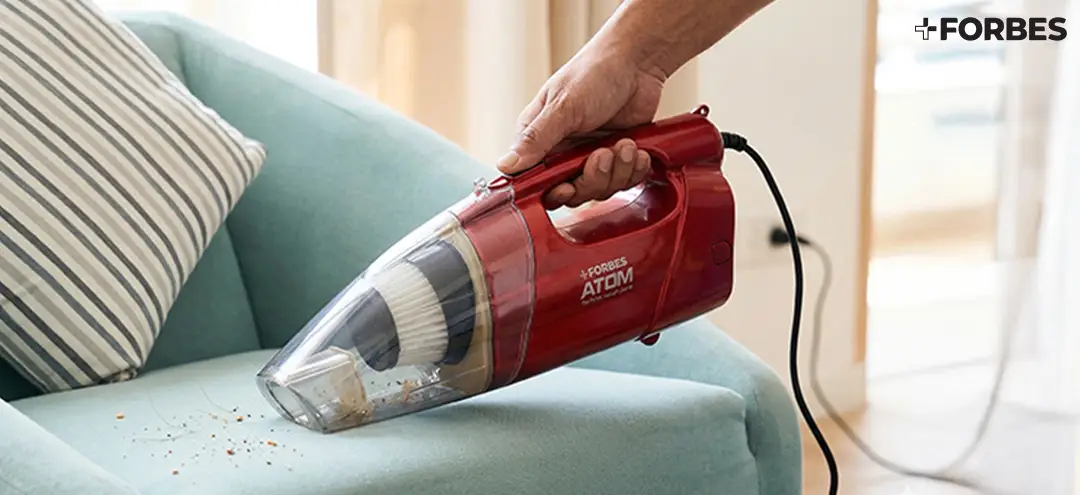
Top Mistakes to Avoid When Using a Handheld Vacuum Cleaner at Home
PUBLISHED ON: 25-Mar-2026
Key Takeaways:
- Handheld vacuum cleaners are designed for quick, easy cleaning tasks and perform best when used within their intended limits.
- Simple habits like timely dust bag emptying and regular filter cleaning have a major impact on suction and the lifespan of the vacuum cleaner.
- Handheld vacuums should never be used to clean wet messes; there are specific wet and dry vacuum machines for that.
- Convertible upright cordless vacuum cleaners can offer greater flexibility by combining full-size cleaning power with handheld convenience.
Compact, lightweight, and convenient, a handheld vacuum cleaner is ideal for quick clean-ups such as removing crumbs, fine dust, and light debris. Despite their simplicity, improper usage can gradually reduce cleaning performance.
Their compact design allows easy access to tight spaces, while long cord or cordless functionality improves mobility. With specialised attachments and low maintenance needs, they enable faster, more frequent clean-ups, helping maintain a consistently tidy and hygienic environment with minimal time and effort.
However, despite their simplicity, improper usage can gradually reduce cleaning performance. Understanding what to avoid helps maintain consistent suction, prevents unnecessary strain on components, and extends the appliance’s lifespan.
Why Proper Use Matters
Handheld vacuum cleaners are designed with compact motors, smaller dust compartments, and fine filtration systems. While efficient for targeted cleaning, these design characteristics can also make them more sensitive.
Incorrect usage can lead to reduced suction, airflow blockages, and battery inefficiencies. In most cases, performance issues arise not from product faults but from avoidable handling and maintenance habits.
Common Handheld Vacuum Cleaner Mistakes to Avoid
Overfilling the Dust Bag
One of the most frequent user errors is delaying the emptying of the dust bag. Because the bag in a small vacuum cleaner is compact, it fills faster than people expect. When overloaded, airflow becomes restricted, directly reducing suction efficiency.
Regular emptying not only preserves performance but also prevents dust from accumulating inside the chamber, which can later cause blockages.
Ignoring Filter Cleaning and Maintenance
Filters are essential in the maintenance of the cleaning flow and to capture finer dust. Over time, these particles accumulate and eventually limit the flow.
Many users underestimate how much the filter condition influences cleaning efficiency. A clogged filter restricts airflow, forcing the motor to work harder and reducing dust pickup. Regular cleaning, especially in homes with fine dust or pet hair, is essential for maintaining consistent suction.
Well-designed vacuum cleaners often make filter maintenance quick and simple, reducing the chances of neglect. The Forbes Easy Clean Plus Handheld Vacuum Cleaner, for instance, uses a bagless feature for easy dust disposal and includes multiple cleaning accessories that help users tackle varied surfaces more effectively. Its lightweight design and long power cord also make routine cleaning less cumbersome, which indirectly supports more regular upkeep.
Cleaning filters as recommended helps to ensure continuous operation and prevents damage to the internal components. This tip is relevant to all battery-operated as well as wired hand vacuum cleaners.
Using a Handheld Vacuum for Heavy-Duty Cleaning
Handheld vacuum cleaners are mainly used to pick up light debris, and not to pick up larger ones. Using a handheld vacuum cleaner to clean large areas or thick carpets can cause the vacuum to overheat or the battery to run down quickly.
While handheld vacuums are not replacements for full-sized cleaners, higher-power models can still deliver impressive performance for daily cleaning needs. For example, compact units equipped with strong motors and efficient airflow are well-suited for removing stubborn dust from upholstery, shelves, and corners.
One such example is the Sure from Forbes Compact Handheld Vacuum Cleaner, designed specifically for quick yet effective cleaning. Its 700-watt motor generates strong suction, making it suitable for lifting embedded dust, while the blower function helps clear debris from hard-to-reach spaces. The washable HEPA filter further supports cleaner air output by trapping fine particles.
For other cleaning needs, a larger vacuum or upright vacuum will be more appropriate.
Vacuuming Wet or Damp Debris with a Dry Model
Most of the handheld vacuum cleaners are designed to work only as dry cleaning machines. Vacuuming liquids or humid substances with a dry cleaning device may damage the filter and motor.
If wet cleaning is required, a dedicated vacuum machine designed for wet and dry messes should be used instead. These cleaners are equipped with appropriate separation systems along with moisture-resistant components.
Improper Storage and Handling
As it is portable, the small vacuum cleaner is often stored carelessly by inserting it into overcrowded cabinets, automobiles, or drawers. Consequently, it may damage tools or batteries.
Keeping the device in a clean, dry location and ensuring that the accessories are not subject to pressure will help maintain it appropriately.
Conclusion
A handheld vacuum cleaner has unmatched convenience for use in everyday cleaning over the bigger vacuum cleaners. The equipment’s effectiveness, however, largely depends on appropriate usage habits. For instance, timely emptying, filter cleaning, and knowledge of its limitations can play a major role in enhancing its lifespan.
Frequently Asked Questions
Can a handheld vacuum cleaner replace a full-sized vacuum cleaner?
Handheld vacuum cleaners are designed for quick, targeted cleaning rather than deep, whole-house cleaning. They work best for furniture, car interiors, corners, and small spills. For larger floor areas or heavy debris, a full-sized vacuum cleaner remains more suitable.
How long should a handheld vacuum cleaner be used in one cleaning session?
The length of usage may vary depending on vacuum types, though handheld vacuums tend to be used optimally for a short time period. It may accumulate heat or cause battery exhaustion if used continuously.
Is a handheld vacuum cleaner useful for dusting ceiling fan blades?
Yes, it is true that a handheld vacuum cleaner is quite helpful when it comes to cleaning the fan blades of a ceiling fan, especially if it has a brush available. One needs to, however, be careful not to stretch the handheld device beyond a certain point while trying to reach the ceiling fan.
Can a cordless vacuum cleaner be used as a vacuum cleaner for car cleaning?
Yes, cordless vacuum cleaners are well-suited for car cleaning due to their portability and ease of use. A vacuum cleaner for car interiors should ideally be lightweight, compact, and equipped with attachments to reach tight spaces, making cordless options a practical choice for quick and efficient cleaning.
