How Water Hardness Varies Across Indian Cities: A State-by-State Overview
PUBLISHED ON: 30-Apr-2026
Key Takeaways
- The level of hardness in water varies significantly from city to city, region to region in India, majorly influenced by groundwater sources and local geology.
- Even within the same city, hardness levels can differ depending on the water supply source, whether it is municipal-based or borewell-based.
- Hard water can impact daily life over time, affecting appliances, plumbing, and personal care, like skin or hair.
- Although the right solution depends on your local hardness level, installing a water softener for the whole house can help manage hardness effectively.
The presence of high amounts of minerals such as calcium and magnesium in water across several cities in India results in hard water. The impact of hard water is felt in various ways, ranging from clogging of household equipment to dryness of skin and hair.
It should be noted that the hardness level varies from region to region, even within the same city, depending on regional water sources and geological conditions.
Reasons Behind the Regional Variation in India?
The level of hardness in water is determined by the soil and rock types (igneous, metamorphic and sedimentary) that water interacts with before getting into people's homes.
Some of the factors contributing to hard water in India are:
- Topography: Areas having limestone, chalk, and gypsum usually have high mineral content in their water supply.
- Source of Water: Municipalities using borewells and underground water sources usually experience a high level of hardness in their water compared to the towns receiving water from river sources or treatment plants.
- Industrial Activity: In some regions, the hardness of water might increase due to industrial effluents that seep down to the ground and get mixed with the groundwater. In some cases, these industrial effluents are discharged directly into a river stream, which can be a source of water for many domestic households.
State-by-State Overview
Based on observation data of groundwater quality from the Central Ground Water Board (CGWB), municipal supply data, and BIS drinking water standards (IS 10500), the level of hardness in water across Indian regions generally falls into the following categories.
Local variations may occur depending on the water source.
Category | Regions / Cities (Indicative) | Typical Hardness (mg/L) |
Very Hard | Rajasthan, Gujarat, Haryana, Madhya Pradesh¹, parts of Uttar Pradesh² (groundwater-dependent areas) | Above 600 |
Hard | Punjab, Maharashtra, Karnataka (borewell-dependent areas)³ | 300–600 |
Moderately Hard | Tamil Nadu⁴, Telangana | 150–300 |
Relatively Soft | Kerala, coastal regions⁵, parts of West Bengal (treated municipal supply)⁶ | Below 150 |
These values are based on the classification ranges given by BIS and commonly observed regional patterns. The actual hardness levels may vary within the same city depending on the source.
City-Level Examples: How Water Hardness Differs in Places
Regional patterns provide a broad understanding of water hardness. These levels of hardness can vary significantly even within the same city, depending on the source of supply.
- Delhi NCR: Areas dependent on groundwater or borewells usually experience hard water, whereas treated municipal supply tends to have relatively moderate levels of hardness.
- Bangalore: Many residential areas rely on borewell water, which generally has high levels of hardness. This is why the use of a water softener for a house or even a water softener for bathroom has become common in apartment complexes.
- Chennai: Here, water hardness varies across zones, tanker and groundwater sources often show higher mineral content compared to the treated supply.
- Mumbai: Here, municipal water supplied in the city is generally softer, but some suburban areas using borewell water may still experience a moderate level of hardness in water.
Impact on Households
The effects of hard water are not always immediate; they become visible over time in both household systems and personal care. Living in cities with hard water in India often comes with challenges, such as:
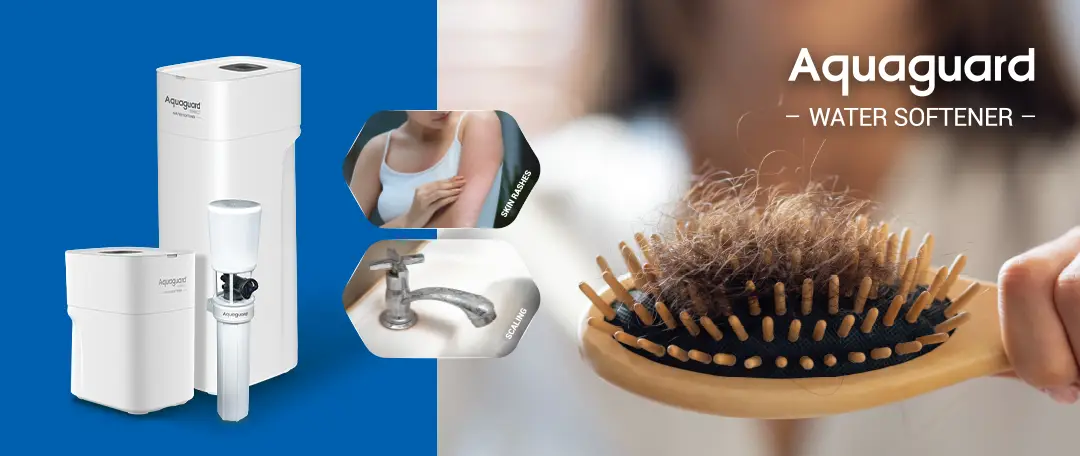
- Scale Buildup on Plumbing & Fixtures: Mineral deposits form scale inside pipes and leave white stains on taps and fittings, reducing their lifespan.
- Dry Skin and Hair: Hard water can lead to skin dryness and rough hair.
- Low Appliance Performance: Geysers, washing machines, and dishwashers become less efficient due to scale buildup, increasing energy consumption, and maintenance needs.
What Should People Do?
Managing hard water does not always require a heavy monetary investment and a complete overhaul. You should focus on the severity of hardness and your specific usage before making a decision.
1. Test Your Water
It is advisable to test the hardness level in your water using a TDS meter or test kits, which will help you know whether it is moderate or high water hardness, and what can be done to counter this issue.
2. Choose a Water Softening System
Choosing the right hard water softener depends on how severe the hardness issue is in your home. Hard water affects plumbing, appliances, and personal care, so the solution should match both severity and the total water usage. Most of the water softeners work on the principle of ion exchange, where calcium and magnesium ions are replaced with sodium ions, making water softer and more usable.
Whole House Water Softening System
It is installed in the home water tank, treating all incoming water. It uses ion exchange resin to remove hardness-causing minerals like calcium and magnesium, and regenerates using a salt solution.
It is ideal for moderate to high hardness levels and protects pipes, appliances, and ensures consistent soft water across the home.
Water Softener for the Bathroom
It is a compact and point-of-use system fitted to a shower or geyser line. It also uses ion exchange but is designed for less water consumption. It helps in reducing the scale buildup, improves soap lather, and minimises dryness in skin and hair, making it a practical solution for targeted use.
3. Additional factors to consider
Choosing a reliable hard water to soft water converter is important and requires careful consideration of a few additional factors, as they influence both performance and ease of use.
These factors are:
- Regeneration Method: It is a process through which the water softener regenerates its resin after use. Usually, there are two types of regeneration methods from which you can choose – automatic and manual. Automatic regeneration is more convenient and suitable for busy households, whereas manual systems provide hands-on control to the user, suitable for households with low water usage.
- Salt Consumption: Salt is used during regeneration to restore the softening capacity. Lower salt consumption means reduced running costs and better efficiency.
- Capacity: It refers to the total amount of water the system can treat before regeneration. Higher capacity systems are better for larger households or higher water usage.
Conclusion
Water hardness in India varies from region to region, making it important to understand the quality of water in your specific area. From scale buildup and white residue in your appliances to its impact on your skin and hair, the effects of hard water are gradual but become apparent over time.
Addressing this requires more than basic filtration. A suitable water softening solution, whether for the entire house or a specific water softener for the bathroom, helps manage mineral content effectively and improves overall water usability.
References:
- https://cgwb.gov.in/cgwbpnm/public/uploads/documents/1762854375262680475file.pdf
- https://pmc.ncbi.nlm.nih.gov/articles/PMC10914837/
- https://cgwb.gov.in/cgwbpnm/public/uploads/documents/17363272771910393216file.pdf
- https://www.twadboard.tn.gov.in/content/water-quality-standards
- WATER-QUALITY-REPORT-HARD-ROCK-TERRAIN-Kerala.pdf
- https://cgwb.gov.in/cgwbpnm/public/uploads/documents/170799987922095186file.pdf
Frequently Asked Questions
Does the BIS/IS 10500 standard set a limit on water hardness?
Yes. The Bureau of Indian Standards (BIS) specifies an acceptable limit of 200 mg/L for total hardness. In the absence of an alternative source, a permissible limit of up to 600 mg/L is allowed, though it is not ideal for long-term household use.
Does water hardness change by season in Indian cities?
Yes, it can vary. During summer, as groundwater levels drop, mineral concentration often increases, making water harder. Monsoons may dilute mineral levels in some areas.
Will a water softener effectively soften hard water?
Yes. A properly installed water softener uses ion-exchange technology to remove calcium and magnesium, converting hard water into soft water and making it more suitable for daily use.
