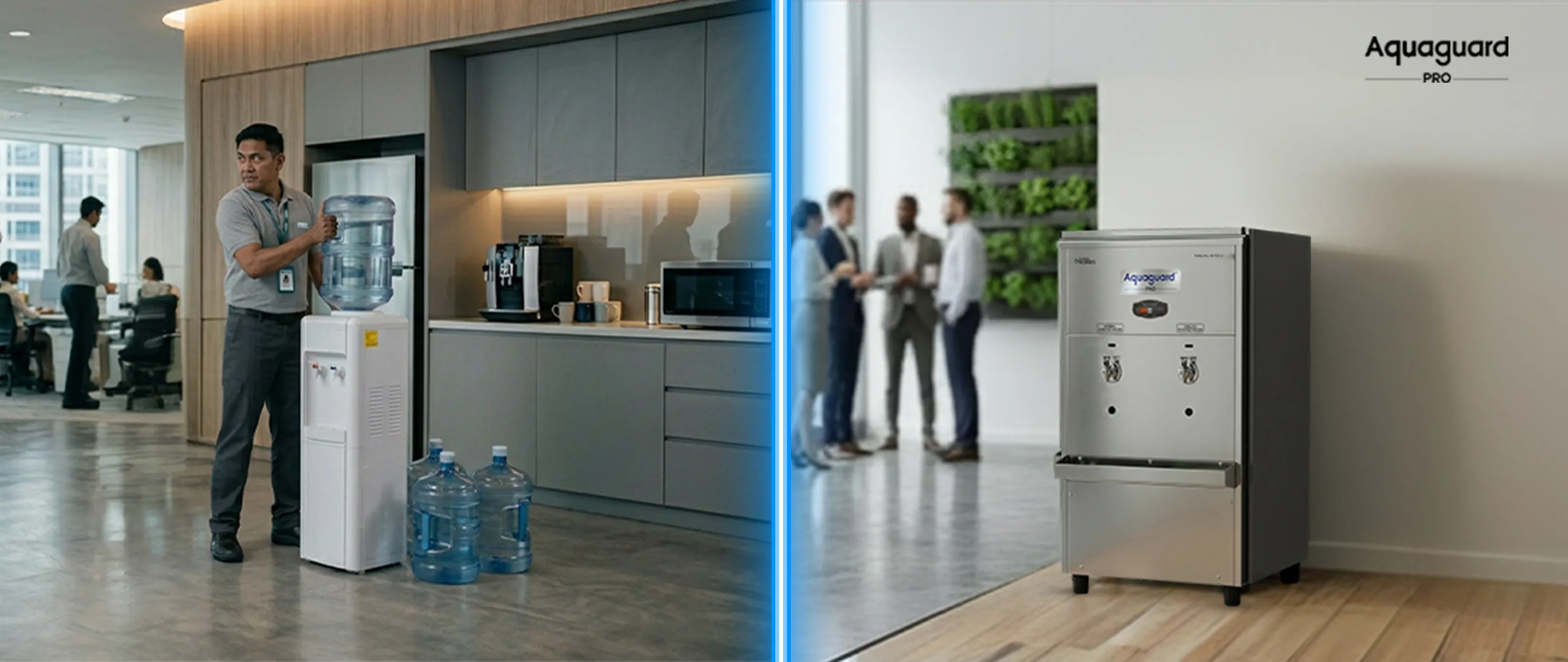
ROI of Installing a Commercial Water Purifier vs Buying Bottled Water
PUBLISHED ON: 06-Jun-2026
Key Takeaways
- Bottled water may seem convenient at first, but recurring delivery costs can make it expensive in the long run.
- A commercial water purifier comes with initial higher expenses, but over time contributes to savings.
- Beyond cost savings, a commercial water purifier improves water quality, sustainability and employee convenience.
Every organisation, whether it is a 50-80-person office, a bustling restaurant, or a 200-bed hospital, needs one critical thing without fail: clean, safe drinking water. For this, organisations have had different approaches in the past. One went for a bottled water supply, another opted for a 20-litre water jar supplied by a local vendor.
Earlier, this seemed cost-effective and manageable, but as the strength of employees increased along with daily water consumption, recurring bottled water expenses soared along with plastic waste. This is where a commercial water purifier comes into the picture and changes the whole equation.
Instead of paying for a recurring bottled water supply and managing its storage, installing a commercial water purifier can contribute to savings and cost-effective maintenance in the long run.
Now you must be thinking, how is a commercial water purifier going to save money? This blog will answer that question by comparing the ROI between buying bottled water and installing a commercial water purifier.
Cost of Bottled Water
The actual cost of bottled water is not just the price printed on it. It involves other costs as well, especially in a commercial setup. On average, an individual drinks approximately 2-3 litres of water¹, depending on the climate, activity level and workplace conditions.
If we take the example of a 50-member office, the daily drinking requirement will be around 100-150 litres a day.
The table below provides a basic idea of the overall costs attached to buying bottled water.
Expense | Estimated Monthly Cost |
Approx daily requirement | 100 -150 litres |
20-litre water jars needed in a day | 5-8 jars |
Average cost per jar | ₹80 - ₹120 |
Monthly jar expense | ₹ 12,000 - ₹28,800 |
Extra deliveries in case of peak demand | Additional charges depending on the need and urgency |
Additional operational effort | Storage space, handling and refill coordination |
Annual expenditure | ₹1.44 lakh - ₹3.45 lakh |
Hidden costs of bottled water include:
- Delivery delays during peak summer
- Dependence on external supplies
- Plastic management costs
- Uncertainty of water quality.
Cost of a Commercial Water Purifier
A commercial water purifier may require a higher upfront cost, however, operating costs per litre become lower over time.
Below is a cost breakdown of a commercial water purifier in a tabular form for your reference.
- We have taken a 25 -50 LPH (litre per hour) capacity commercial water purifier for comparison.
Expense Component | Estimated Cost |
Initial purifier installation | ₹ 50,000 - ₹ 1.5 lakh (The installation cost varies based on the purifier capacity, filtration technology, storage size and commercial use) |
Filter replacement | ₹1,070 - ₹8000 annually (depending on the model) |
Electricity consumption | Approximately ₹400 - ₹1,000 per month (commercial electricity tariff in Mumbai is ₹8.40 per unit)² |
Maintenance Cost | ₹599 - ₹1,100 per year |
Approximate lifespan of the purifier | Around 5 to 10 years |
Commercial water purifiers are cost-effective for the following reasons:
- Continuous supply of purified water
- Reduced dependency on external suppliers
- Better monitoring as they come with multi-stage filtration technology comprising RO, UV/UF, and activated carbon filters. This may lead to better monitoring of water quality.
- Scalable for growing workforce requirements.
- For instance, a commercial water purifier with a 50-litre storage will produce 50 LPH, and is usually suitable for different commercial setups ranging from corporate offices to small workshops.
- No issue of plastic waste management-related cost
ROI Calculation
Here is a simplified ROI comparison of commercial water purifier vs bottled water cost, and other associated costs like daily maintenance, in a tabular form.
Sample ROI formula: ROI = net profit/cost of investment x100
Here, net profit is the savings minus the cost of investment.
| Parameter | Bottled water | Commercial water purifier |
| Daily water requirement | 100 -150 litres | 100 -150 litres |
| Monthly water expense | ₹12,000 - ₹28,800 | ₹539 - ₹1,759* |
| Annual operating cost | ₹1.44 - ₹3.45 lakh | ₹6469 - ₹21,108 |
| Upfront investment | minimal | Approx ₹50,000 - ₹1.5 lakh |
| Estimated lifespan | Not applicable | 5 to 10 years |
| Approx 3-year cost | ₹4.32 - 10.35 lakh | ₹69,407 - ₹2.13 lakh |
| Potential savings in 3 years | — | Approx ₹3.63lakh - ₹8.22 lakh |
* Includes monthly electricity consumption, filter replacement allocation, and routine operational cost.
- Electricity cost = ₹400 - ₹1,000 per month.
- Filter replacement cost= ₹1070 - ₹8000 annually (to convert it into monthly = 1,070/12= ₹89 per month and 8000/12= ₹667 per month)
- Maintenance costs = ₹599-₹1,100 annually ( to convert it into monthly= 599/12= approx ₹50 per month and 1,100/12= approx ₹92 per month)
Large establishments like factories can struggle with a bottled water supply, as it can significantly increase their annual costs and contribute to plastic waste. Because of this, they often opt for a centralised RO plant to provide consistent and safe drinking water.
However, the RO plant price varies with capacity (250 LPH or 1000 LPH), existing water quality, and filtration systems. While water suppliers reach out to the businesses themselves, in some cases, businesses explore an RO plant near me on Google to find a suitable system for their needs.
Non-Financial Returns That Strengthen the ROI Case
With the table above, you can understand the potential savings you can have in a three-year period with a commercial water purifier in comparison to bottled water. However, there are some non-financial returns as well.
1. Water quality consistency
Commercial setups are expected to install a BIS-compliant water purifier:
- IS 10500³ defines the acceptable drinking water quality standards, including the limits for pH and TDS.
- IS 16240⁴ mentions the performance and safety requirements for RO-based water purifiers.
In the case of bottled water, you may not be sure if it is in compliance with BIS.
2. Employee productivity and satisfaction
A commercial water purifier provides a continuous supply of clean drinking water without any disruptions. However, in the case of bottled water, there is a chance of running out of water during peak hours, which may lead to employees' dependence on buying their personal bottled water from outside. In the case of a water dispenser, refilling may require manual handling, which can affect the water quality of the jar.
Studies have highlighted that easy access to clean water improves hydration levels, focus and overall comfort of the employees. This can lead to an increase in the overall work efficiency of the employees.
3. Sustainability and ESG reporting
A 50-person office consumes approximately 8 jars of bottled water in a day, generating approximately 1,000 -2,000 plastic jars per year.
Whereas a water cooler with an in-built purifier eliminates the plastic jar consumption, thereby reducing plastic waste. In the current ESG (Environmental, Social, and Governance) reporting framework, SEBI’s BRSR (Business Responsibility and Sustainability Reporting) requires the listed companies to disclose their environmental impact metrics. Installing a commercial water purifier will contribute to their commitment to zero plastic use.
4. Vendor dependence elimination
Bottled water or jar water operations are heavily dependent on the vendor. Any kind of disruptions in the supply, like vehicle breakdowns, festive holidays, or delivery strikes, can interrupt the water supply to the offices.
On the other hand, a commercial water purifier is connected to your building’s main water supply, removing the dependence on an external party entirely. Similarly, a centralised RO plant for a factory will continue to provide clean drinking water for daily use, eliminating external dependence.
5. Regulatory compliance confidence
Businesses like restaurants, cafes, and small food processing facilities operate under FSSAI licensing that requires documented evidence of a safe water supply. This documented evidence is difficult to provide in the case of bottled water or jars due to dependence on external supply and manual handling (broken seals during delivery or in storage can contaminate the bottled water).
However, this process is simplified with a commercial water purifier, as it provides a traceable, documented purification system with defined filter change records and service logs.
Which Commercial Water Purifier to Choose?
Eureka Forbes provides multiple commercial water purifiers consisting of RO commercial water purifiers, water coolers with an inbuilt purifier and storage, and RO plants, which can be suitable for your daily use:
1. Aquaguard Prima 100-B Commercial Water Purifier
- Contains 7 stages of purification:
- Sedi-filter
- Chemi block
- MLE (membrane life enhancer, which protects the RO membrane from scaling and clogging).
- RO (reverse osmosis cartridge)
- Post Carbone
- UV e-boiling
- Provides 1000 LPH of purified water, making it suitable for large-scale demand.
- Consists of a self-cleaning system, where automatic membrane flushing helps in maintaining performance and hygiene with limited manual intervention.
- Comes with a 1-year warranty + 1 maintenance visit.
2. Aquaguard Purechill 40PSS RO+UV Water Cooler with Inbuilt Puriifer and Storage
- Comes with & stages of purification:
- Sedi-filter
- Chemi Block
- MLE (membrane life enhancer)
- RO
- Active copper booster cartridge
- ZincUV and e-boiling
- Calcium
- Magnesium
- Integrated purifier and cooler eliminates the need for separate installations.
- Has a storage capacity of 40 litres and provides 25LPH of purified water and 20 LPH of cooled water.
- Comes with a 1-year warranty + 1 maintenance visit.
3. Aquaguard RO-250 RO plant
- It is completely pre-assembled.
- Provides 250 LPH of purified water
- Automatically activates or halts purification based on the water level in the storage tank, preserving energy.
- Suitable for commercial kitchens, factories, hospitals and schools.
Conclusion
While bottled water or jars offer convenience, their recurring costs can become financially high for growing businesses. A commercial water purifier provides a more scalable, cost-efficient, and sustainable solution for offices, hotels, restaurants, and other commercial facilities.
Other than direct cost savings, the long-term ROI includes operational stability, employee convenience, reduced plastic waste, and better compliance readiness. For businesses with high daily water consumption, installing a commercial water purifier is usually a smarter long-term investment.
Frequently Asked Questions (FAQs)
How long does it typically take for a commercial water purifier to pay for itself compared to bottled water costs?
For many medium-sized offices, the payback period ranges from 6 to 24 months, depending on the price of the purifier installed, the price of the bottled water or jar, and daily water consumption.
Does ROI calculation change significantly for a hotel or a restaurant compared to a regular office?
Yes, hospitals and restaurants generally consume large quantities of water in comparison to a regular office, which increases their bottled water expenses significantly. Because of this, commercial water purifiers often deliver faster ROI in the hospitality sector.
How much water does a commercial water purifier produce per day? Is it enough for a full office?
Commercial water purifiers come with different capacities, typically ranging from 25 LPH to 500+ LPH, which is sufficient for a full office.
References
- https://www.ncbi.nlm.nih.gov/books/NBK579449/
- https://electricbill.in/en/maharashtra-electricity-bill-calculator
- https://phedwater.rajasthan.gov.in/content/dam/doitassets/water/Ground%20Water/Pdf/waterqualitychartsandstandards/WQ-standards.pdf
- https://www.bis.gov.in/wp-content/uploads/2023/04/PM-IS-162403.pdf
