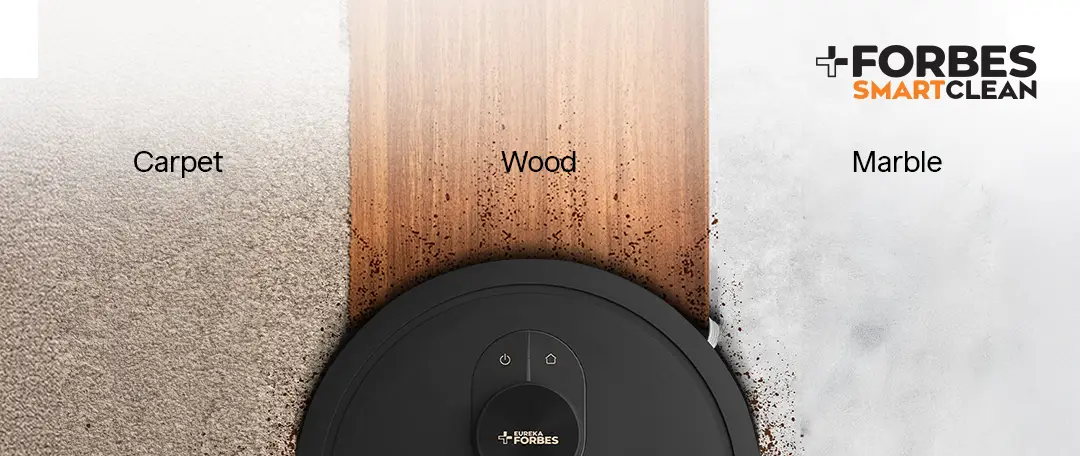
How to Deep Clean Carpets vs Hard Floors: Different Vacuum Settings Explained
PUBLISHED ON: 06-May-2026
Key Takeaways:
- Carpet vacuuming requires higher suction power, along with the brush roll, in comparison to hard surfaces, where the brush roll should be removed.
- Techniques of cleaning matter as much as the machine itself. Carpets require slow and multi-directional vacuuming. Whereas hard floors require daily vacuuming with low suction power.
- Using incorrect vacuum settings leads to inefficient cleaning and can lead to damage to the floors.
Have you ever noticed that a vacuum cleaner moves smoothly across the floor but then starts to struggle when it meets the carpet? This is exactly what Rupa faced one afternoon while cleaning her home in Nagpur. Her vacuum cleaner picked up the dust effortlessly on the wooden floor. But the moment she began to clean the carpet, her machine started giving her trouble. Frustrated, Rupa was about to give up when her daughter pointed out one thing that the vacuum settings needed to be changed. Since what works for a hard floor may not work for a carpet.
This blog will help you understand the types of vacuum settings and their suitability.
Why does a Different Surface Require a Different Cleaning Technique?
Different types of floors trap dirt and dust differently. For instance, carpets trap the dust particles vertically deep inside the fibres, whereas hard surfaces trap dust horizontally within the gaps and lines. Using a hard surface-specific vacuum setting on carpet can leave dirt untouched, leading to inefficient cleaning. However, buying a multipurpose vacuum cleaner makes it easier for consumer to manage their cleaning routine as they come with a proper tool kit for different cleaning purposes.
Understanding the Key Vacuum Settings
Vacuum cleaners come with different types of settings, making them more effective for cleaning different surfaces.
The following table may give a brief idea about the vacuum settings, what they do and where they should be used.
Vacuum setting | What it controls | carpet | Hard floor |
Suction force | Airflow strength | high | low-medium |
Roller brush | Agitates the surface | on | off/removed |
Soft roller head | Gentle surface contact | Not needed | essential |
Bare floor mode | Disables agitator | off | on |
Sealed suction/boost mode | Maximum deep clean | For thick carpets | Never |
Carpet vs Hard Floor Cleaning: Key Differences in Vacuum Settings
Dust particles behave differently on carpets and hard floors. For instance,
- The carpets generally require higher suction power vacuum cleaners as they trap dust particles and hair deep in their fibres, whereas the hard floors require low to medium suction power as the dirt remains on the surface of the hard floor, making it easier to clean and scatter at the same time.
- In the case of carpets, an active brush roll would help loosen the dirt. However, in the case of a hard floor, the brush roll is supposed to be removed to prevent scratching.
- The carpets require a higher height to allow proper airflow and movement, whereas, in the case of a hard floor, a lower height is preferred for efficient cleaning.
Best Vacuum Settings for Deep Cleaning Carpets
To deep clean your carpets, you should know the right kind of vacuum cleaner and the right kind of vacuum settings it needs.
Step -by- step guidance:
- Pre-clean pass: Use a low suction pass first to collect the debris before deep cleaning.
- Attach brush-roll: The brush roll agitates the carpet floor, dislodging the dirt, pet dander, and hair from the carpet fibres.
- Slow vacuuming: Most people vacuum too fast, leaving dirt trapped in the carpet. You should vacuum slowly, as slower movement allows suction to dwell longer and ensure deeper cleaning.
- Direction of vacuuming: Move the vacuum in the opposite direction of the fibre’s natural direction. This will lift the fibres and loosen the dirt stuck in the carpet fibres. Then vacuum in the same direction as the fibres to collect the loosened debris effectively.
- Busy areas: Areas such as hallways, entrances and living rooms tend to accumulate more dirt. These areas require 2-3 rounds of vacuuming, as a single round would generally remove less dirt.
- Deep pile rugs: These rugs have long, loose fibres that can get tangled in the brush roll. To prevent this, one should switch off the brush roll and rely on suction alone, with the vacuum head slightly elevated for cleaning.
Best Vacuum Settings for Hard Floors Without Causing Damage
Vacuum settings differ with the surface types. Hard floors require slightly different features from carpet floors.
Step-by-step guidance:
- Use the right kind of attachment: Use a soft roller to gently trap the dust and hair.
- Floor brush: Use a floor brush attachment while cleaning a hard surface such as tiles, marble and wooden floors to lift dust and debris.
- Low suction: A very high suction can make the vacuum stick to the floor, making it difficult to move. Hence, prefer low to medium-suction power.
- Grout lines and edges: They need to be cleaned separately with the crevice tool, as the vacuum head cannot reach them.
- Vacuuming sequence: Start with the cleaning of edges and corners, and gradually move to the open area to prevent dirt from reaching already cleaned areas.
- Polished surfaces: Ensure that the vacuum head is clean, as the trapped debris in the wheels and brushes can leave marks on the polished surfaces.
Modern vacuum cleaners are multipurpose in nature and can be used for cleaning a wide variety of floors. One such example is the Eureka Forbes Cordless Zerobend Z15 vacuum cleaner. It can be used as a vacuum cleaner for carpet after attaching a brush roll to it. Similarly, it can be used to clean hard surfaces like tile and wood floors by attaching a floor brush to it.
Common Mistakes that Damage Floors or Reduce Cleaning Effectiveness.
People often unintentionally make mistakes while vacuuming, which reduces the effective cleaning and can damage surfaces.
These mistakes include:
- Using a brush roll on a hard floor.
- Vacuuming carpets without the brush roll.
- Vacuuming quickly, which can leave debris on the surface instead of getting sucked inside the vacuum cleaner.
- Running over the power cables, deep pile rugs with a brush roll. They can get entangled and jam the brush roll.
- Skipping filter cleaning as a clogged filter cannot clean the surface effectively, irrespective of which vacuum setting is selected.
You should avoid these mistakes to ensure efficient cleaning, protect the floors and extend the lifespan of the vacuum cleaner.
Conclusion
Having a good vacuum cleaner is not enough for a thorough cleaning. You also need to use the right vacuum settings for different types of surfaces. The best results in carpet cleaning and hard floor cleaning require different approaches with regard to the suction power, brush roll and cleaning technique. This would avoid unnecessary damage to the machine or to the surface. Therefore, buying a multipurpose vacuum cleaner for the home is a practical choice, as it comes with multiple cleaning tools in one package. Considering the vacuum cleaner price alongside these features can help make a well-informed decision.
Frequently asked questions (FAQs)
Q.1 Can I use the same vacuum head for both carpet and hard floors, or do I need separate attachments?
Yes, you can use the same vacuum head for both carpet and hard floors if you use a robot vacuum cleaner. However, you can also buy vacuum cleaners with multi-usage cleaning tools, such as the Eureka Forbes Stick Vac NXT Vacuum Cleaner for a deep cleaning experience.
Q.2 My carpet still looks flat and dull after vacuuming. What setting am I getting wrong?
The most common mistakes that people make are vacuuming too fast, setting the pile height either too high or having clogged filters. Try vacuuming slowly, clean or replace the filter and keep the pile height slightly low.
Q.3 Is the robot vacuum's automatic surface detection reliable enough, or should I manually configure settings?
Yes, robot vacuum’s automatic surface detection is reliable and does not require any manual intervention. It can be controlled through the Smart Life app.
Q.4 How often should I deep clean carpets vs. hard floors, and does that change the settings I use?
Hard floors in the living room or dining room benefit from a light daily vacuum, instead of infrequent heavy cleaning. Carpets, on the other hand, benefit from less frequent but thorough cleaning sessions, such as 2 to 3 slow multidirectional passes.
