How RO, UV & RO+UV Technologies Work in Storage Water Coolers
PUBLISHED ON: 27-Jan-2026
In busy workplaces and public spaces, access to safe drinking water cannot be left to chance. Storage water coolers with inbuilt purification help meet this daily need by delivering clean, chilled water throughout the day. However, the real importance lies not in cooling but in how effectively the water is purified.
This is where technologies like RO, UV, and RO+UV come in—understanding how these systems work helps you choose the right water cooler with a purifier for your needs.
This blog will help you understand how these technologies work in storage water coolers, when to use each one, and how they support safe drinking water in commercial spaces.
How RO Technology Works in Storage Water Coolers
Reverse Osmosis (RO) is one of the most effective purification methods used in a water cooler. Water is pushed through a semi-permeable membrane. The membrane blocks dissolved salts, heavy metals, and chemicals, allowing only purified water to pass through.
This RO purification process is especially useful when water has high TDS or dissolved impurities.
Key benefits of an RO water cooler:
- Removes dissolved salts and heavy metals.
- Improves taste and clarity.
- Suitable for borewell or mixed water sources.
RO technology is commonly used in commercial areas where water quality varies.
How UV Technology Works in Storage Water Coolers
UV purification uses ultraviolet light to make water safe for drinking. It works by exposing water to UV light. This helps in neutralising bacteria, viruses, and microorganisms, preventing them from multiplying. A UV water cooler does not change the taste or mineral content of water. It is ideal when water is already clear but may contain biological impurities.
Key benefits of UV water coolers:
- Effective against harmful microorganisms.
- Maintains the natural taste of water.
- Low maintenance and fast purification.
UV systems are widely used in offices, clinics, and institutions with treated municipal water.
How RO+UV Technology Works Together
An RO+UV water cooler combines the strengths of both technologies.
- RO removes dissolved and chemical impurities
- UV ensures microbiological safety
Together, they provide complete protection, making RO+UV ideal for commercial spaces with mixed or uncertain water sources. This combination is often preferred in large offices, factories, and institutions where consistent water quality cannot be guaranteed.
Choosing the right technology ensures safe water without unnecessary complexity. To decide between RO, UV, or RO+UV, ask these questions:
- What is the water source?
- Is the water treated or untreated?
- How many people use the cooler daily?
- Is the space commercial or institutional?
The answers will guide you towards the right water cooler with a purifier for your environment.
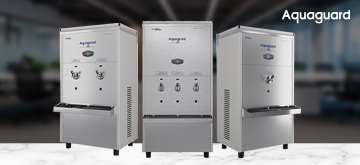
Aquaguard Storage Water Coolers with Advanced Purification
1. Aquaguard Purechill 40PSS UV+CuZn Water Cooler
Designed for offices and shared commercial spaces, this UV water cooler offers reliable purification and cooling in one compact unit.
Key benefits include:
- Advanced UV purification for microbiologically safe water.
- Nanopore long-life filters for protection from chlorine and organic chemicals
- Inbuilt cooling system for instant cold water during peak usage
- Durable steel body suited for commercial environments
- Active copper technology for a mineral-enriched water cooler experience
- Compact all-in-one design that saves space
2. Aquaguard Purechill 120 PSS UV+CuZn ACH Water Cooler
Built for commercial environments, this model combines purification, storage, and multiple temperature options.
Key benefits include:
- Advanced UV purification for safe drinking water
- Hot, cold, and ambient water dispensing from one unit
- Large stainless steel storage tank for high usage
- Durable steel body for long-term commercial use
- Active copper technology supporting everyday wellness
- Suitable for offices, institutions, and commercial kitchens
Conclusion
Understanding how RO, UV, and RO+UV technologies work helps you make an informed choice. Each technology serves a specific purpose, and the right option depends on water quality, usage, and location. With thoughtfully designed solutions from Aquaguard, storage water coolers can deliver both purity and performance without any compromise.
Frequently Asked Questions (FAQs)
Which is better for use: RO vs. UV in commercial water coolers?
The right choice between RO and UV water coolers depends on the quality of the incoming water. A UV water cooler is suitable for treated municipal water where TDS levels are already within safe limits, as UV technology disinfects water by eliminating bacteria and viruses. A RO water cooler is recommended when water has high TDS, dissolved salts, heavy metals, or chemical impurities, as RO coolers actively perform TDS reduction and improve both safety and taste. For commercial locations with mixed or uncertain water sources, an RO+UV water cooler offers the most reliable solution by combining effective TDS reduction with microbial disinfection to ensure consistent drinking water quality.
Is UV purification enough for drinking water in offices?
Yes, UV purification for drinking water is effective when the water is clear and already treated. UV light neutralises bacteria and viruses, making it suitable for offices, clinics, and institutions using municipal water.
What are the benefits of a water cooler with copper and zinc technology?
A water cooler with copper-zinc water cooler technology adds beneficial minerals to the water. This supports everyday wellness while ensuring the water remains safe. Having a mineral-enriched water cooler can be suitable for all age groups.
