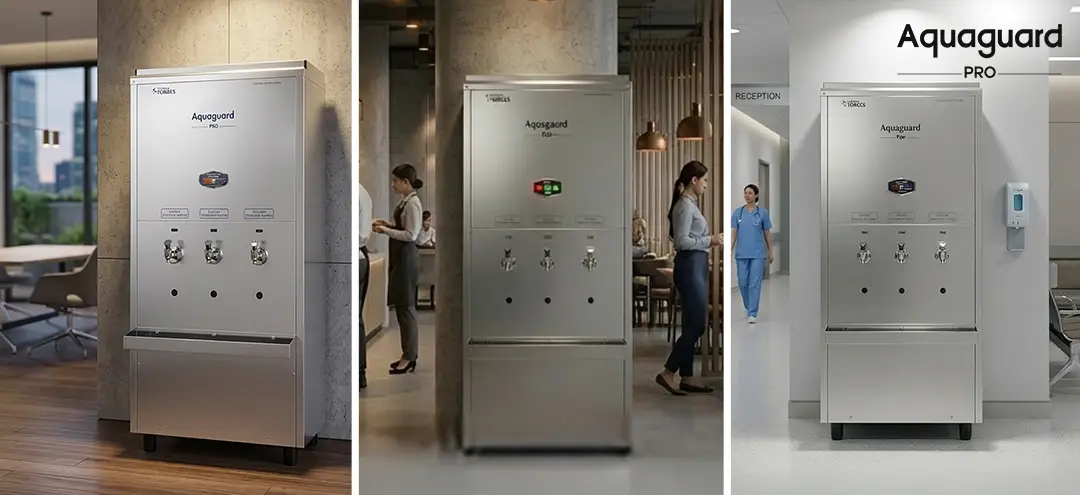
Guide on Installation of Commercial Water Purifier
PUBLISHED ON: 31-Mar-2026
Key Takeaways:
- Proper installation directly influences the performance and reliability of a commercial water purifier. Pressure balance, plumbing accuracy, and drainage design often determine system stability more than the equipment itself.
- Pre-installation checks, including inlet pressure, electrical supply, and space planning, help prevent avoidable operational disruptions and premature component stress.
- Post-installation checking is essential. Leak inspection, pressure verification, flow assessment, and water quality testing confirm that the system operates within intended parameters.
- Water source variability continues to affect maintenance cycles. Municipal, borewell, and tanker water each impose different scaling and filtration demands, shaping long-term system behaviour.
In most commercial environments, a drinking water purifier is not questioned for quality once installed. It quietly becomes part of the infrastructure and is expected to deliver consistent output day after day. Attention usually arrives only when irregularities begin to surface: slower dispensing, unexpected taste variations, rising maintenance calls, or unexplained drops in production capacity.
Such problems are often attributed to filters, membranes, or inlet water quality. Yet, in practice, many operational inefficiencies originate much earlier, during installation itself. Commercial purification systems, whether a commercial RO plant, a commercial water purifier, or a water cooler with an inbuilt purifier, are highly dependent on hydraulic balance, pressure stability, drainage design, and environmental conditions.
Pre-Installation Planning: Things to Check Before Installation
Before installing a commercial RO water purifier or an RO plant, a professional performs a site check to ensure everything is in place for smooth operation. This step helps identify any requirements in advance so that the system can be installed correctly and functions efficiently from the start.
- A technician assesses the water supply availability at the site
- The power connection is checked to ensure stable operation
- Drainage arrangements are reviewed for proper wastewater disposal
- The installation space is evaluated for placement and servicing access
- Overall site readiness is confirmed before proceeding with installation
Once the site inspection is complete, the technician installs the water purifier, ensuring the system is set up properly and ready for use.
Professional Installation Process: What Happens During System Setup
Commercial water purification systems are installed by trained technicians to ensure proper setup and smooth operation. The process is handled entirely by professionals, reducing the chances of errors.
During installation, the technician places the unit in the designated area, connects the water inlet and outlet, and ensures all components are properly fitted. They also check that the system is functioning correctly and that water flow is smooth.
Once installed, the system is tested to confirm that it is working efficiently and is ready for regular use. Any misalignment at this stage can affect purification efficiency and long-term membrane performance.
Post-Installation Checks and Testing
After installation, a series of validation tests ensures the system is stable.
- Pressure levels, leak integrity, and flow characteristics are checked for signs of early system failure. Even the slightest inconsistencies in joints can impact efficiency in the long run.
- Water quality measurements help verify purification effectiveness. For purifiers that come with a water cooler, dispensing rates, storage response, and cooling capabilities are also tested.
- Short observation cycles enable installers to identify any pressure variations or drainage anomalies before the system goes into continuous use.
Water Source Variability and Its Impact on Maintenance
Even after a commercial water purifier or RO plant is properly installed, real-world water conditions continue to shape system performance. In commercial environments, inlet water characteristics can vary significantly depending on the source.
Municipal water may fluctuate in turbidity and carry disinfectant residues, while borewell or tanker supplies often introduce higher hardness and dissolved solids. Over time, these variations affect membrane efficiency, scaling behaviour, and filter loading.
As a result, many maintenance issues are not due to equipment failure but changes in water quality, making it important to check the water source for long-term system reliability.
Installation Considerations Across Common Commercial Purifier Types
Commercial water treatment systems vary according to the level of usage, water quality, and intended use. Different types of purifiers are designed to cater to particular needs.
Commercial RO Water Purifiers
These are suitable for use in offices, clinics, hospitals, and small business organizations with moderate water usage. The water purifiers are designed to provide a balance between purification and space optimization. Purifiers such as the Aquaguard Reviva 50-B Commercial Water Purifier are suitable where water is available at a controlled and consistent flow rate, ensuring the purifier does not produce too much or too little water at any given time.
It ensures a reliable and consistent supply of purified water and helps in optimising system efficiency and reducing wear and tear, which can support longer equipment life and smoother operation.
Commercial UV Water Purifiers
These are intended for use in situations where microbiological purity is the main objective. UV water purifiers mainly focus on killing bacteria and viruses to make water safe. Models like the Aquaguard Pro 200 UV Commercial Water Purifier are ideal for institutional or municipal water supply systems.
Commercial RO Plants
Built to handle high water demand and effectively treat water with high levels of dissolved solids. A commercial RO plant provides large-scale purification by reducing hardness, TDS, and contaminants. Systems such as the Aquaguard RO-500 RO Plant are more relevant for factories, hostels, hospitals, and large facilities.
Water Coolers with Inbuilt Purifiers
Integrated units combine purification with storage and temperature control. These are ideal for workplaces, educational institutions, and public-access areas requiring chilled water. The Aquaguard Purechill 80 PSS UV+CuZn Water Cooler with Inbuilt Purifier and Storage is one of the great options if you need a water cooler with purifier benefits.
Conclusion
A commercial water purifier, whether a compact UV unit or a high-capacity commercial RO plant, functions as a critical infrastructure component. Filtration technologies, membrane design, and purification stages perform optimally only when supported by stable inlet conditions, correct pressure balance, and properly engineered drainage pathways.
Oftentimes, performance inconsistencies observed in commercial RO plants and purification units are not inherent system flaws but consequences of configuration or installation gaps. Treating installation as a technical process rather than a mechanical setup activity significantly reduces operational uncertainty.
Reliable water purification is less about equipment selection alone and more about installation precision, inlet understanding, and ongoing validation. When these factors are addressed correctly, commercial purification systems deliver predictable, long-term performance with minimal disruption.
Frequently Asked Questions
Does improper installation affect the performance or warranty?
Yes. Installation errors involving pressure settings, electrical safety, or drainage design can affect purification behaviour and component durability. Warranty terms often assume compliance with recommended installation guidelines.
Why is professional installation recommended for commercial water purifiers?
Commercial water purifiers involve specialised calibration requirements and safety considerations. Professional installers minimise the risk of pressure imbalance, membrane misalignment, and hidden operational inefficiencies.
Can a commercial water purifier be installed outdoors?
Outdoor placement requires environmental safeguards. Exposure to heat, dust, and moisture can affect filters and electronics. Protective enclosures and controlled conditions are generally recommended.
