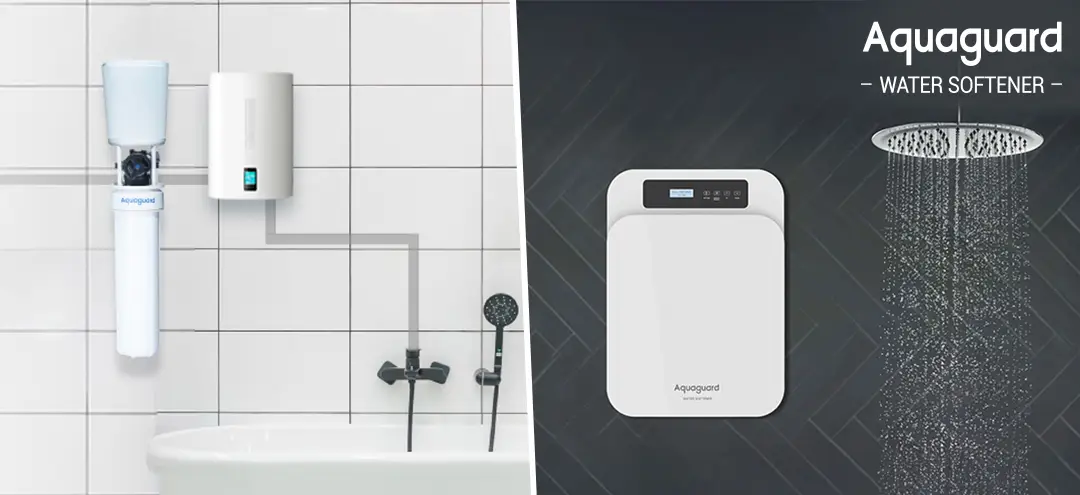
Difference Between Manual and Automatic Water Softeners
PUBLISHED ON: 30-Mar-2026
Key Takeaways:
- Manual and automatic water softeners perform the same core function but differ mainly in regeneration control and user involvement.
- Manual water softeners require active monitoring and user-initiated regeneration, making them suitable for predictable water usage.
- Automatic water softeners manage regeneration independently, offering greater convenience and more consistent soft water output.
Hard water is a common issue in many homes, often leading to scaling on fittings, reduced appliance efficiency, and changes in everyday water usage. To tackle this, households turn to water softeners that treat water before it flows through bathrooms, kitchens, and other utilities.
When choosing a water softener, the decision usually comes down to two types: manual and automatic. While both are designed to soften hard water, they differ in how they operate, regenerate, and the level of maintenance they require.
Understanding these differences is key to selecting the right hard water softener for long-term convenience and efficiency.
What Is a Manual Water Softener?
A manual water softener requires the homeowner to initiate the regeneration process, which restores the resin’s ability to remove hardness-causing minerals.
Over time, the resin beads become saturated and need to be regenerated. At this point, the user must manually start the process by turning a valve or using a control switch, allowing salt and water to flush out the trapped minerals.
What Is an Automatic Water Softener?
An automatic water softener follows the same softening process, but handles regeneration on its own using timers or water usage sensors. It doesn’t rely on the homeowner to start the cycle, making it especially useful in homes with varying water usage.
By triggering regeneration when needed, it maintains consistent performance and avoids efficiency loss. Designed for convenience, it works on a set-and-forget basis, with minimal day-to-day maintenance beyond refilling salt.
Differences Between Manual Vs. Automatic Water Softener
Feature | Manual Water Softener | Automatic Water Softener |
Regeneration Control | User starts regeneration manually | System triggers regeneration automatically |
User Involvement | Requires regular monitoring and action | Minimal intervention after setup |
Consistency of Soft Water | Depends on timely regeneration by the user | More consistent due to automated cycles |
Risk of Missed Regeneration | Possible if the user forgets | Rare, as the system self-manages |
Best Suited For | Homes with predictable water usage | Homes with variable or high usage |
Convenience | Suitable for users comfortable with manual operation | Ideal for busy households |
Examples of Manual and Automatic Water Softeners
If you are looking to invest in a hard water softener for the home, here are two examples to choose from:
1. Manual Water Softener
A great example of this category is the Aquaguard AWS I-600, a manual water softener designed for bathrooms and appliances.
- Its wall-mounted compact body makes it suitable for small spaces, while the clearly labelled 5-stage valve allows users to perform softening, regeneration, and cleaning functions manually.
- As it operates without electricity, it remains functional even during power cuts.
- Manual softeners like these are particularly useful for specific water points such as bathroom where they work as a perfect water softener for hair and skin by providing soft water in showers, for clothes in washing machines, or in the kitchen for dishwashers.
2. Automatic Water Softener
An example of an automatic system is the Aquaguard Select AWS C-1200, designed for households requiring consistent soft water with minimal intervention.
- Supporting a flow rate of up to 1000 LPH, it uses advanced ionic-transfer technology to soften water by reducing hardness minerals, which may help limit effects commonly associated with hard water, such as scaling, higher soap consumption, and dryness concerns.
- The advantage of this system is that it does not require manual regeneration. Once set, the softening media regenerates automatically, enabling a set-and-forget experience.
- Features such as IntelliMix Technology for adjustable softness levels, up-flow regeneration for improved efficiency, and a compact design make it suitable for modern homes with variable water usage patterns.
Conclusion
Both manual and automatic water softeners effectively tackle hard water and the issues that come with it. The real difference lies in the level of convenience they offer.
Manual systems work well for households with consistent water usage and those comfortable managing regeneration themselves. Automatic systems, on the other hand, are built for ease, handling regeneration independently with minimal effort.
The right choice ultimately depends on your lifestyle, water usage patterns, and priorities, whether that’s protecting appliances, improving skin and hair health, or simply reducing daily hassle.
Frequently Asked Questions
How often does a manual water softener need regeneration?
The frequency depends on water hardness and daily consumption. In many homes, regeneration may be needed every few days or weekly. More usage usually means more frequent cycles.
Do automatic water softeners consume more salt and water?
Not necessarily. Some automatic water softeners are designed to optimize regeneration according to usage, which may be more efficient. Salt and water usage depend on the model and type of water softener.
What if I forget to regenerate a manual water softener?
If you forget to regenerate your water softener, the resin can become fully saturated, which may decrease its efficiency. You may notice the presence of hard water again, which may cause scaling or a lack of lather in soap.
How do I decide between a manual and an automatic water softener for my home?
You may consider your lifestyle and water usage. If you do not want to be bothered with the maintenance process of a water softener system, an automatic water softener is a good choice.
