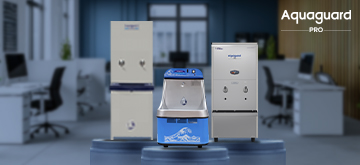
Which Technology Does Your Business Need? Comparing Commercial RO, UV, and UF Systems
PUBLISHED ON: 19-Feb-2026
Key Takeaways:
- RO removes dissolved salts and heavy metals, ideal for hard or contaminated water.
- UV disinfects without altering taste, suitable for microbiologically unsafe water.
- UF retains essential minerals while removing sediments and microbes.
- Multi-stage systems offer a balance of safety, compliance, and efficiency for commercial operations.
A commercial water purifier is designed to meet the higher drinking water demands of businesses and institutions. These systems are commonly used in offices, clinics, factories, educational institutions, and hospitality facilities. They employ multiple filtration stages to remove contaminants from the water. The purified water helps protect equipment, ensure regulatory compliance, improve operational efficiency, enhance product quality, and support sustainability.
One of the most important features to consider before choosing a system is its technology. Evaluate the purification technology used, such as RO, UV, UF, or a combination, to ensure it effectively removes contaminants in your source water while maintaining essential minerals and taste. Advanced features like smart sensors, automatic flushing, and IoT monitoring can improve efficiency and reduce maintenance.
Other important features include source water quality, daily water demand, compliance and safety standards, budget and total cost of ownership.
Understanding Different Technologies- RO, UV, and UF
Commercial water purifiers use different technologies to remove impurities, each suited for specific water quality and usage requirements.
What Is Reverse Osmosis (RO) and How It Works
A commercial RO water purifier is a water treatment system designed to provide large volumes of purified water by removing dissolved salts (TDS), heavy metals such as lead and arsenic, chemicals, bacteria, and viruses. It is ideal for areas with hard water, high salinity, or contaminated groundwater.
In a commercial RO system, water first passes through sediment and carbon filters before the RO membrane, which allows only water molecules to pass while blocking impurities. The purified water is then stored in tanks or delivered directly to equipment or taps.
What Is Ultraviolet (UV) Purification and How It Works
A commercial UV water purifier removes harmful germs from water without using chemicals. Water flows through a chamber where a UV lamp kills bacteria, viruses, and protozoa. Since no chemicals are added, the water’s taste, smell, and minerals stay the same.
UV purification is often included as part of a multi-stage system, combined with RO or UF for comprehensive water treatment.
What Is Ultrafiltration (UF) and How It Works
Ultrafiltration (UF) is a water purification process that removes bacteria, viruses, sediments, sand, rust, cysts, and colloidal particles. In this process, water passes through a semi-permeable membrane with microscopic pores (approximately 0.01 microns), which block contaminants while allowing clean water and dissolved minerals to pass through.
This method retains essential minerals while improving the taste and safety of water. UF commercial purifiers are suitable for areas where water has low salinity but is microbiologically unsafe. Like UV filtration, UF is often used as a pre-treatment stage before RO or UV systems.
RO vs UV vs UF: Quick Comparison Table
The table below provides a clear overview of the key features and differences between RO, UV, and UF systems, making it easier to compare their suitability for different business needs.
Feature | RO | UV | UF |
| Water source compatibility | Works well with tap, borewell, and municipal water | Suitable for water with low to moderate TDS | Works with water that has low TDS and minimal turbidity |
| TDS handling | Reduces high TDS effectively | Does not remove TDS | Removes suspended particles but not dissolved salts |
| Power requirement | Requires electricity | Requires electricity | Can work without electricity in some models |
| Maintenance level | Moderate to high | Low to moderate | Low |
| Ideal business use | Offices, hotels, and restaurants with variable water quality | Clinics, offices, and restaurants with microbial concerns | Schools, small offices, and cafes with low TDS water |
Water Quality Standards by Industry
Different industries have specific water quality requirements to ensure safety, hygiene, and operational efficiency. Understanding these standards helps businesses choose the right commercial water purification system.
Food and Beverage Industry
As per FSSAI water quality standards, water in the food and beverage industry must be chemically safe, microbiologically free from harmful organisms, and have a neutral taste and odour. A multi-stage system combining an RO water purifier for commercial use with UV and UF filtration ensures pure, hygienic water for processing and beverage preparation.
Healthcare and Laboratories
Water in healthcare facilities and laboratories must be ultra-pure for critical applications such as dialysis, laboratory testing, sterilization, and pharmaceutical preparations. These standards are governed by the Bureau of Indian Standards (BIS) under IS 10500:2012 for drinking water and laboratory use.
Hospitality and Commercial Buildings
Commercial and hospitality establishments must provide pure, potable water for occupants and visitors. The water should be clear, odourless, free from harmful microorganisms, and within the prescribed limits for TDS, nitrates, fluoride, and heavy metals.
The Aquaguard 200 UV is designed for commercial use, offering a large water flow rate of 200 L/hour, ensuring the drinking water requirements of offices, clinics, and institutions are met. Its UV water purification technology is capable of destroying harmful microorganisms while preserving the natural taste and odour of the water. The reverse flow feature, along with electronic monitoring and an LCD display, makes it easy to maintain and ensures safe access to purified water.
Manufacturing and Industrial Use
Water treatment for manufacturing and industrial use is governed by BIS IS 10500 for potable water and Central/State Pollution Control Board (CPCB/SPCB) regulations to ensure the safety of water for staff consumption. The purification requirements vary by industry, such as food, pharmaceuticals, textiles, or chemicals, while ensuring compliance with CPCB discharge standards and meeting internal operational needs.
A commercial RO water plant is a high-capacity purification system designed to provide pure and continuous drinking water for offices, institutions, and industrial facilities. The Aquaguard RO-500 RO Plant is an ideal choice for such settings, delivering up to 500 litres/hour through multiple dispensing points. Its robust stainless-steel construction, integrated pre-treatment module, and microprocessor-based control ensure safe, high-quality water while protecting system components. Fully pre-assembled for quick installation, energy-efficient auto start/stop, and scalable design make it a dependable solution for continuous, commercial-grade drinking water.
Conclusion
Selecting the right commercial water purifier is essential for providing a safe and reliable source of water for employees, customers, and business operations. By matching the quality of the water, the level of demand, and industry requirements, businesses can safeguard equipment, maintain efficiency, and meet regulatory requirements with a sustainable and reliable solution.
