How Should You Choose the Right Water Purifier for Your Home Based on Your Area's Water Quality in India?
PUBLISHED ON: 13-Nov-2026
From Kashmir to Kanyakumari, every area in India receives a different quality of water. Some households rely on municipal water supply, while others depend on underground borewell water or tanker water supply. Many areas also use a mixed water supply. Each water source carries different levels of minerals, mud, and Total Dissolved Solids (TDS). Because water quality varies, a single filtration method cannot suit every household.
If you want to buy the right water filter for home, you can start by identifying your water supply and testing its TDS levels. Selecting the proper technology ensures your drinking water is safe and properly purified.
Know Your Water Source and TDS Level
- Your water source determines what impurities enter your home. Indian households generally receive water from four main sources:
- Municipal Water- Supplied by local authorities after large-scale treatment. However, old distribution pipes can introduce rust and dirt.
- Borewell Water - Drawn from deep underground. It usually contains higher mineral content, dissolved salts, and high TDS levels. Learn more about borewell water purification if your household depends on groundwater with higher dissolved mineral and salt levels.
- Tanker Water - Collected from varying sources. Its quality fluctuates, and it may contain suspended solids or microbes.
- Mixed Water Supply - A combination of municipal and borewell water.
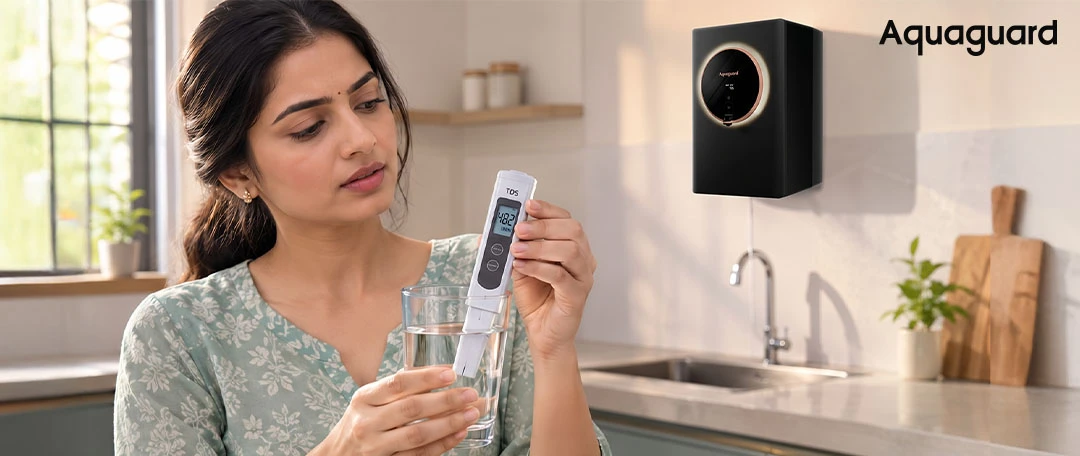
Total Dissolved Solids (TDS) refers to the inorganic salts and small amounts of organic matter dissolved in water. You can check this level easily using a handheld TDS meter. According to the Bureau of Indian Standards (IS 10500:2012), the desirable limit for TDS in drinking water is up to 500 mg/l. Knowing your water source and exact TDS level helps you select the correct water purifier for your home.
Matching Purifier Type to Water Quality
Different water conditions require specific types of water purifiers and purification methods. Choosing the wrong system can lead to under-purified water or unnecessary filter wear.
- Low TDS Water (Below 200 ppm): Municipal water usually has a lower TDS level. For this source, Ultrafiltration (UF) or Ultraviolet (UV) technology is recommended. These systems neutralize bacteria and viruses without altering the natural mineral balance.
- High TDS Water (Up to 2000 mg/l): Borewell or tanker water often contains heavy metals, pesticides, and high dissolved salts. Reverse osmosis (RO) technology is necessary here. An RO water purifier reduces heavy metals, dissolved salts, and hardness to make the water safe for consumption.
Nowadays, water purifiers combine all the technologies to bring you the best of all worlds. For example, Aquaguard Aspire Nova Pro 2X RO + UV Stainless Steel IOT water Purifier has a combination of both RO and UV technologies that is designed to deliver clean drinking water with ease and intelligence.
Top 10 Features You Should Consider When Buying a Water Purifier
Water purifiers by Eureka Forbes incorporate multi-stage filtration to enhance efficiency. You get features like:
- Aquaguard Nanopore Long-Life Filters: Advanced filtration that offers longer filter life and blocks contaminants like lead, arsenic, cadmium, microplastics, pesticides, bacteria, viruses, and cysts.
- Mega Sediment Filter: Removes fine dust, dirt, and mud particles from water, which prevents clogging and thus extends the life of internal filters.
- Titanium Duo Filter Technology: Delivers long-lasting filtration for up to 2 years or 12,000 litres (for input water TDS <1000), with 40% higher water recovery and 60% faster filtration.
- Active Copper: It infuses the right amount of copper, calcium, magnesium, and other essential minerals as per BIS norms, making it suitable for all age groups.
- Water Saving RO Technology: The advanced filter, with its increased surface area, ensures more than 40% water recovery as well as faster filtration rate than regular ROs.
- Stainless Steel Storage: Some stainless-steel water purifiers feature a large storage tank made of surgical grade 304 Stainless Steel that is corrosion-free, tough, durable, and comes with a Lifetime Warranty.
- Smart IoT & Wi-Fi Connectivity: Enables remote monitoring and control via the Eureka Forbes app for added convenience.
- 5th. Gen UV LED: Provides instant purified water with zero wait time. It contains zero harmful mercury and lasts longer up to 10 years.
- Water Source Compatibility: Should be ideal for municipal, borewell, and tanker water (TDS up to 2000 mg/L).
- 21-Point Device Health Check: It helps you continuously monitors filters, pump, UV lamp and other critical components for reliable performance.
Find the Best-Selling Range of Water Purifiers
Water purifier price in India varies depending on several factors. These factors include the number of purification stages, storage tank material, filter lifespan, and smart indicators.
At Eureka Forbes, water purifiers for homes are designed for different budgets and water conditions. Some of the best-selling Aquaguard water purifiers include:
- Aquaguard Sure Delight 2X UV+UF Water Purifier: Suitable for municipal water with low TDS (<200 ppm). It features UV e-Boiling, Ultra Filtration 2X, and a Mega Sediment Filter.
- Aquaguard Sure Delight 2X Aquasaver RO+UV+UF Water Purifier: Built for high TDS water up to 1000 ppm. It features Aquaguard Nanopore Long-Life Filter with high water recovery and a 2 year* filter life.
- Aquaguard Aspire Halo 2X RO+UV Active Copper Alkaline Stainless Steel WQI Water Purifier: Features a Surgical Grade 304 Stainless Steel Tank, 5th Generation Mercury-Free UV LED, Intelligent Halo Lights, and a Water Quality Indicator (WQI) display.
Quick Decision Checklist
Use this quick checklist before buying a water purifier for home:
- Test TDS Level: Use a TDS meter to check your input water TDS.
- Identify Water Source: Confirm if your supply is municipal, borewell, or tanker.
- Check Power & Water Pressure: Ensure your kitchen installation site has a standard electrical outlet and adequate water pressure.
- Select Storage Capacity: Choose a storage tank size (e.g., 5L to 7L) based on your family's daily drinking needs.
- Verify Service Plans: Check for genuine AMC and filter warranty options to maintain performance.
Choosing the right water purifier requires matching your home's water source and TDS level with the correct filtration technology. Testing your water quality helps you invest in the right system to keep your household safe.
Frequently Asked Questions
Is RO necessary for low TDS water?
No. Low TDS municipal water (below 200 ppm) does not require RO purification. A UV or UF water purifier is suitable for removing bacteria and viruses while retaining natural minerals.
What's the difference between RO, UV, and UF?
RO reduces dissolved salts, heavy metals, and high TDS. UV uses light to disinfect bacteria and viruses. UF uses a fine membrane to filter microplastics, cysts, and suspended solids without removing dissolved minerals.
How often should purifier filters be changed?
Water purifiers featuring Aquaguard Nanopore Long-Life Filter Technology can last for up to 2 years*. Filter replacement depends on input water quality and usage. However, it is recommended to get the entire purifier serviced within 6-12 months as a part of regular maintenance.
Is RO-purified water safe for daily drinking?
Yes. RO purified water is safe for daily drinking when used for high TDS water sources, as it blocks harmful contaminants like lead, pesticides, and heavy metals.
