Borewell vs Municipal Water Purifiers: Which One Suits Daily Use Better?
PUBLISHED ON: 01-Oct-2026
Key Takeaways
- Borewell water has more TDS and hardness content, which makes RO treatment a preferable option by default.
- Municipal water is relatively softer but could be biologically contaminated due to leakage in pipelines and tanks.
- The right purifier depends on an actual water test, not assumptions based on the source alone.
If you're choosing a water purifier for your home, the first question is usually about the source: is it borewell water, municipal supply, or a mix of both? The answer matters because borewell and municipal water tend to carry very different impurities, and using the wrong purification technology can mean paying for filtration you don't need, or worse, missing out on the filtration you do.
This guide breaks down what typically shows up in each water source, which purifier technology usually works best for it, and why a water test still beats guesswork every time.
What is Usually Found in Borewell Water
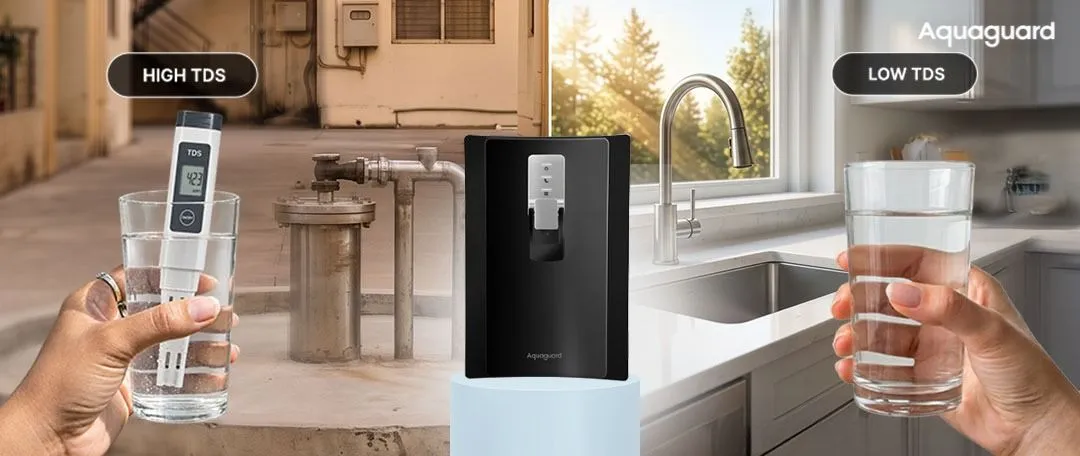
Borewell water is drawn from underground aquifers, so its composition depends heavily on the local soil and rock. This means higher total dissolved solids (TDS) for most parts of India, often way above the BIS acceptable limit of 500 mg/l.
The borewell water in some areas may also have excess fluoride, nitrate, or iron. Groundwater is not treated before it reaches your tap, and hence there is a risk of bacterial contamination too, particularly if the borewell is shallow or near a source of seepage.
This is the reason why borewell water often requires more intensive purification than water from a treated municipal line, because of the combination of high mineral content and possible microbial risk.
What is Usually Found in Municipal Water
Municipal water is generally obtained from surface water bodies such as rivers or reservoirs and treated before it is supplied. Therefore, it has a lower TDS and hardness as compared to borewell water.
However, water can still pick up contamination on its way to your home, through ageing pipelines, storage tank buildup, or intermittent supply that lets contaminants enter the system when pressure drops.
Chlorine used for disinfection can also leave behind an odour or taste that many households want filtered out. So while municipal water is usually gentler on your purifier in terms of mineral load, it still needs protection against biological and residual contaminants before it's ready to drink.
The Purifier Technology Each Source Usually Needs
What works best often comes down to where your water is coming from. Here is a general breakdown by source:
Borewell Water
➔ Typically, high in TDS and hardness, which makes an RO water purifier for borewell water a preferred choice for most households. Because RO is built to handle dissolved solids and minerals that other systems can't
➔ If microbial contamination is also a concern, RO is usually paired with UV or UF water purification for added protection.Municipal Water
➔ Generally lower in TDS, so UV/UF alone is often enough, since these technologies target biological contamination rather than dissolved solids
➔ RO can still add value here; it improves taste, removes chlorine residue, and catches any dissolved impurities that slip through.Mixed or inconsistent water sources
➔ If your supply combines municipal and borewell water, or water quality tends to fluctuate, an RO+UV+UF combination is usually the safer bet.
It's worth stressing that this is guidance, not a rule. The real deciding factor is what's actually in your water, and that can only be confirmed through testing, not assumptions based on where the water comes from.
Why Testing Your Water is Important
Two homes in the same neighbourhood, even on the same borewell line, can show noticeably different TDS and hardness readings. Groundwater quality can vary from one plot to the next depending on depth, local geology, and even the season. The same is true for municipal water, where quality can shift depending on your distance from the treatment plant or the condition of the pipeline serving your building.
This is why assuming "I'm on borewell, so I need RO" or "I'm on municipal supply, so UV is enough" can lead to either overspending or, worse, under-filtering. A quick water test takes the guesswork out and tells you exactly what your purifier needs to handle.
How to Pick A Suitable Water Purifier for Your Home
After getting your water tested, you can compare features and water purifier prices and decide whether you need a borewell water purifier or a purifier designed for municipal water.
It is preferable to have a water purifier with filters having long-life, so that the filter maintenance becomes easy and you can have access to safe drinking water for a longer duration. Eureka Forbes's water purifiers come with Nanopore Long-life filters, which come with a 2-year and 4-year unconditional warranty, so that you do not have to worry about service cost, spare part cost, and filter cost for 2 years and 4 years respectively.
Eureka Forbes has multiple options to choose from:
1. Aquaguard Sure Hydra UV 2X Water Purifier: Suitable for areas with TDS up to 200mg/L.
Provides advanced purification with Aquaguard Nanopore Long-Life filters.
Equipped with UV e-Boiling technology, which provides pure water equal to over 20 minutes of boiled water.
Comes with 5 stages of advanced purification consisting of Mega Sediment filter, Sedi Shield 2X, Particulate filter, Chemi Block 2X, UV e-Boiling.
2. Aquaguard Aspire Arctic RO Stainless Steel Hot Cold &Ambient Water Purifier: Suitable for areas having TDS up to 2000mg/L.
Comes with Insta Chill technology, which provides chilled water as refreshing as your refrigerator.
Provides instant hot water up to 80°C, as well as ambient water.
Easy to replace filters without having to rely on technicians.
Comes with a built-in child lock to prevent accidental operation.
3. Aquaguard Aspire Nova 2X RO+UV Active Copper Alkaline Stainless Steel Water Purifier: Suitable for both Municipal and Borewell water.
Equipped with Aquaguard Nanopore Long-Life filters, which provide complete protection against microplastics, pesticides, and industrial waste like mercury, arsenic and cadmium.
Comes with 4 –in-one Active Copper Technology that infuses the right amount of copper, calcium and magnesium in the water.
Comes with water-saving RO technology, saving 40% more water.
Get Your Water Tested for Free
Not sure whether your water needs RO, UV, or both? Get a free water and filter check done at home before you decide. It takes the guesswork out of the equation and gives you an actual TDS and hardness reading of your water source.
Conclusion
Borewell and municipal water bring different challenges to your kitchen tap, and the right purifier depends on which impurities you're actually dealing with. While many homeowners look for the best water purifier for borewell water or municipal water, the ideal choice should depend on the source quality.
As a general guide, borewell water usually calls for RO, often with UV or UF support, while municipal water may do fine with UV or UF alone, though RO still helps with taste and residual contaminants. The only way to know for sure is to test your water and match the purifier to the results, not the assumption.
Frequently Asked Questions (FAQs)
Does the taste of water tell me if it's safe?
Not reliably. Water can taste fine and still carry excess TDS, hardness, or bacteria that only a proper water test can detect.
How often should borewell water be re-tested if my TDS levels change seasonally?
Testing every six months, or at the start of each season, helps catch fluctuations in TDS and hardness caused by groundwater changes.
Can I switch from a municipal-only purifier to a borewell-compatible one, or do I need a new unit entirely?
It depends on the model. Some purifiers allow filter or membrane upgrades, but a big jump in TDS usually needs a full RO unit.
Is mixed-source water harder to purify?
Not harder, but it needs a purifier flexible enough to handle varying TDS and biological load, since supply from each source can differ.
Does hard borewell water damage the purifier faster than municipal water does?
Yes, hardness can cause scaling on membranes and components over time, which is why RO purifiers built for borewell water need more frequent servicing.
